Buying a Tenanted Property in Dubai: What Investors Should Check Before Making an Offer
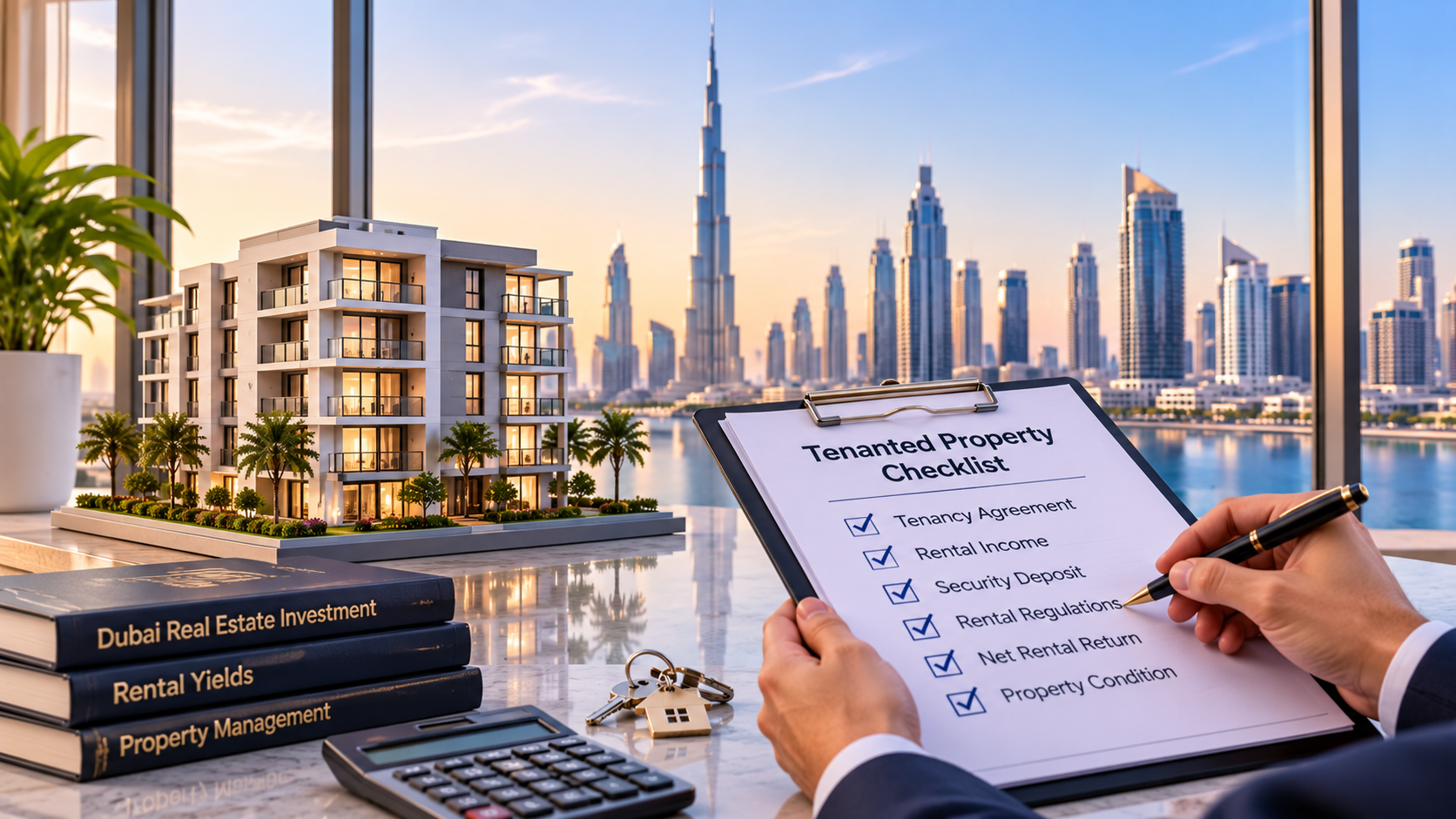
A practical guide to evaluating rental income, existing tenancy agreements and investment potential
Buying an investment property in Dubai does not always mean purchasing a vacant apartment or villa. Many properties available on the secondary market already have tenants living in them under active rental agreements.
For investors, this can present an attractive opportunity. Instead of purchasing a property and searching for a tenant, you may be able to acquire an asset that already generates rental income.
However, buying a tenanted property in Dubai requires additional checks that go beyond the usual property valuation and location assessment.
The existing tenancy agreement, rental payment history, security deposit, maintenance responsibilities and contractual obligations can all influence the value and future performance of the investment.
Before making an offer, here are the key considerations every property investor should understand.
1. Understand the Existing Tenancy Agreement
The first step when purchasing an occupied property is reviewing its existing tenancy agreement.
The agreement provides important information about the relationship between the landlord and tenant, including:
-
Start and expiry dates of the tenancy.
-
Agreed annual rental amount.
-
Payment schedule and number of rental cheques.
-
Security deposit amount.
-
Responsibilities for maintenance and repairs.
-
Additional contractual conditions.
-
Any agreed special arrangements.
Buyers should request a complete copy of the current tenancy agreement and verify that the information matches the seller's disclosures.
It is also important to establish whether the agreement has been registered through Ejari, Dubai's tenancy registration system.
The Dubai Land Department provides official services for registering, renewing and managing tenancy contracts.
You can learn more through the Dubai Land Department's Ejari services.
2. Verify the Current Rental Income
An occupied property may appear attractive because it already produces rental income. However, investors should verify the actual income rather than relying exclusively on the advertised rental figure.
Request supporting information from the seller, including:
-
The agreed annual rent.
-
Rental payment dates.
-
Copies of relevant payment records.
-
Outstanding rental payments, if any.
-
Details of any rental adjustments or amendments.
For example, a property advertised as generating AED 120,000 annually should be evaluated based on the contractual rent and actual payment history.
You should also establish whether the tenant has paid the rent in full and whether any payments remain outstanding.
This helps you understand the property's current financial position before completing the purchase.
3. Check the Tenant's Security Deposit
Security deposits are another important consideration when purchasing a rented property.
Most residential tenancy arrangements include a security deposit intended to cover certain obligations under the rental agreement.
Before completing the transaction, confirm:
-
The original security deposit amount.
-
Whether the tenant has paid the deposit.
-
Whether the seller currently holds the deposit.
-
How the deposit will be accounted for during the ownership transfer.
-
Whether any deductions or disputes exist.
The treatment of the security deposit should be clearly documented between the buyer and seller.
This helps prevent confusion when the tenancy eventually ends and the deposit becomes subject to settlement under the applicable agreement.
4. Understand Your Responsibilities as the New Owner
Purchasing a tenanted property is different from purchasing a vacant property.
As the incoming owner, you should understand the existing contractual arrangements and the responsibilities associated with the property.
These may include:
-
Honouring applicable tenancy obligations.
-
Coordinating maintenance and repairs.
-
Managing communication with the tenant.
-
Addressing service-related concerns.
-
Managing tenancy renewals.
-
Keeping relevant property documentation up to date.
The exact responsibilities depend on the tenancy agreement and applicable Dubai regulations.
Before proceeding, obtain appropriate legal or professional guidance on how the existing agreement and ownership transfer affect your position as the new landlord.
A property purchase should be evaluated not only as an asset acquisition but also as the beginning of an ongoing landlord-tenant relationship.
5. Review the Property's Rental Potential
An existing rental agreement tells you what the property currently earns. It does not necessarily establish what it could earn in the future.
Investors should compare the contractual rent with prevailing rental conditions in the surrounding area.
Consider the following:
Location: Is the property situated in an area with consistent tenant demand?
Property type: Are similar apartments, townhouses or villas attracting tenants?
Condition: Does the property require maintenance or upgrades?
Facilities: Do the building or community amenities support rental demand?
Accessibility: Are public transport, schools, retail outlets and essential services conveniently accessible?
Comparable rentals: How does the existing rental amount compare with similar properties in the same community?
This comparison helps investors understand whether the current tenancy represents competitive rental income or whether the property may require a longer-term rental strategy.
6. Check Rental Regulations and Renewal Conditions
Dubai's rental market operates under specific regulations governing landlord and tenant relationships.
Buyers should understand the rules affecting existing tenancy agreements, particularly when considering future rent adjustments, renewals or changes to the tenancy arrangement.
The Dubai Land Department provides information and services relating to tenancy registration and rental matters.
Investors should pay particular attention to:
-
Existing contractual renewal provisions.
-
Applicable rental adjustment rules.
-
Required notification periods.
-
Conditions relating to tenancy termination.
-
Procedures for resolving landlord-tenant disputes.
Do not assume that purchasing a property automatically allows you to change the rental amount, terminate an existing tenancy or require the tenant to vacate immediately.
Any decision involving a change to the existing tenancy should be assessed against the applicable regulations and contractual requirements.
7. Calculate the Net Rental Return
One of the most important steps in evaluating a tenanted property is calculating its potential net return.
A property's advertised rental yield may look attractive, but ownership expenses can reduce the actual income received by the investor.
Consider the following example:
An apartment generates AED 100,000 in annual rental income.
Its estimated annual expenses are:
| Expense | Annual Amount |
|---|---|
| Rental income | AED 100,000 |
| Service charges | AED 12,000 |
| Property management | AED 5,000 |
| Maintenance allowance | AED 3,000 |
| Net operating income | AED 80,000 |
If the total property acquisition cost is AED 1,500,000, the illustrative net operating yield would be approximately 5.33%.
This is a simplified example before financing costs, taxes or other applicable expenses. Actual results will depend on the property's individual financial circumstances.
The calculation demonstrates why investors should evaluate the income remaining after operating expenses rather than focusing exclusively on gross rental yield.
8. Evaluate the Building and Community
A tenant may be satisfied with the property, but investors should independently evaluate the building and wider community.
The physical condition and management standards of a development can influence tenant satisfaction, rental demand and long-term ownership costs.
During your assessment, consider:
-
General building maintenance.
-
Condition of shared facilities.
-
Security and access arrangements.
-
Parking availability.
-
Community management.
-
Nearby construction activity.
-
Accessibility and transport connections.
-
Current and expected service charges.
It is also worth checking whether there are any known maintenance issues or outstanding property-related obligations that could affect the purchase.
A well-maintained property in a desirable community may offer stronger long-term appeal to tenants.
9. Complete the Necessary Checks Before Ownership Transfer
Before finalising the transaction, buyers should work with their real estate agent and relevant transaction professionals to verify the property's documentation.
A practical due diligence checklist includes:
-
Verify the seller's ownership documentation.
-
Review the current tenancy agreement.
-
Confirm the Ejari registration details.
-
Verify rental payment records.
-
Confirm the security deposit arrangements.
-
Check outstanding service charges.
-
Review applicable maintenance obligations.
-
Confirm any required developer NOC.
-
Clarify how existing rental payments and deposits will be settled.
-
Ensure the sale agreement clearly addresses the property's tenanted status.
It is particularly important to establish the arrangements for rent collected before and after the ownership transfer.
The buyer and seller should agree on how these amounts will be reconciled and documented during completion.
Professional assistance can help ensure that the transaction is properly structured and that both parties understand their obligations.
10. Is Buying a Tenanted Property in Dubai the Right Investment?
A tenanted property can be a suitable investment for buyers seeking an asset with an existing rental arrangement.
However, it is not automatically a better investment than purchasing a vacant property.
The right decision depends on your objectives, financial position and investment strategy.
A tenanted property may be suitable if:
-
You want an investment with an existing rental arrangement.
-
The current rental income is supported by documentation.
-
The tenant has a reliable payment history.
-
The property's operating expenses are manageable.
-
You are comfortable continuing the existing tenancy.
A vacant property may be more suitable if:
-
You intend to move into the property.
-
You want greater flexibility over the initial rental strategy.
-
The existing tenancy does not align with your objectives.
-
You want to renovate or furnish the property before renting it out.
Ultimately, the purchase decision should be based on the property's financial performance, condition, location and suitability for your intended use.
Final Thoughts: Invest With the Right Information
Buying a tenanted property in Dubai can offer investors an opportunity to acquire real estate with an existing rental arrangement.
However, a successful purchase requires more than reviewing the advertised price and expected rental income.
Understanding the tenancy agreement, verifying rental payments, checking security deposits and evaluating ongoing expenses are essential steps in making an informed investment decision.
At Nexus Properties, we help buyers explore Dubai's residential property market with professional guidance and access to available investment opportunities.
Whether you are considering an occupied apartment, a family villa or another income-generating property, our team can help you assess available options based on your requirements.
Looking for investment properties in Dubai?
Explore available listings and connect with Nexus Properties to discuss your next real estate investment.
Website: https://www.nexusproperties.ae/